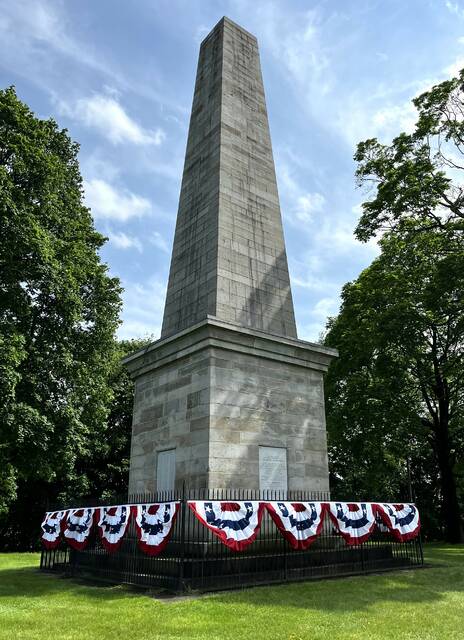
WYOMING — The Luzerne County Historical Society hosted a program this week for its observance of Women’s History Month — highlighting how the Wyoming Monument came to be built and the role local women played in raising funds to construct the monument and tomb to remember those who fought and died in the local Battle of Wyoming on July 3, 1778.
William Lewis, Commissioner of the Pennsylvania Historical and Museum Commission, board member of the Luzerne County Historical Society, and board member of the Wyoming Commemorative Association, said the program came about after the 2024 Wyoming Commemorative Association board meeting.
The Wyoming Masonic Lodge, a close neighbor to the monument, played host to the event, which included presentations by Marian Czarnowski, vice president of the Wyoming Monument Association and board member of the Wyoming Commemorative Association; Judge Jennifer Rogers, board member of the Luzerne County Historical Society and board member of the Wyoming Commemorative Association; and Lewis.
“Judge Rogers, Mrs. Czarnowski, and I were talking about the incredible history of the Wyoming Monument and the amazing role women in the Valley played in raising money for its construction, and they have cared for the Monument ever since,” Lewis said. “Then somebody said if we could only find the cane the women gave to President Hayes, we’d have a new history to add to the incredible story.”
Walking stick
Lewis was referencing the walking stick, which had been presented to President Rutherford B. Hayes when he came to speak at the Wyoming Monument on July 3, 1878, and stayed for three days during the observances of the 100th anniversary of the Battle of Wyoming.
“We all were interested in learning what happened to this local gift to a U.S. President,” Lewis said. “It was mentioned in the book published after the 1878 Battle centennial, as well as contemporary news articles from July of 1878, and it was assumed to have long disappeared, as politicians or their family often gifted items that had been given to them to close associates or political supporters. No one assumed it still existed.”
At the end of Monday’s program, Lewis discussed how the walking stick had been presented to Hayes. Working through historical organizational contacts, he eventually connected with the Hayes Presidential Museum and Library in Fremont, Ohio. The assumption was that they might have some correspondence or a record of the walking stick’s deposition, either by Hayes or his family.
After connecting with the organization’s executive director, they sent Lewis an image of a commemorative coin from the 1878 Battle of Wyoming observance.
“But the next series of images were startling for someone on a history hunt — modern photos of the walking stick on display in their museum, together with an image of the gold handle plate on the stick, noting it being a gift from the Ladies of Wyoming Valley,” Lewis said. “Another mystery was answered as to why Hayes would have been presented with a walking stick was uncovered as well — it turns out President Hayes was an avid collector of canes and walking sticks. So, while many politicians of that era might have passed the stick along to a friend or political supporter, President Hayes added the walking stick to his collection.”
Lewis said he continues to keep in touch with the Hayes Presidential Library and Museum in the hope that maybe in the future, the walking stick can make a return visit to the Wyoming Valley so people can see the humble gift given to a U.S. President almost 150 years ago that the recipient — the President — cherished and made the object one that is proudly displayed in a Presidential museum.
Monday’s program
Lewis said the speakers discussed how the monument came to be built, the designer of the structure — Thomas Ustick Walter — who later in his career became the architect of the U.S. Capitol building and who designed the dome of the U.S. Capitol) — the key role women played in raising funds to build the Monument and the continuing role they played in owning the Monument and its grounds. The important events that have taken place at the Wyoming Monument were also discussed.
“The three of us began to discuss the key role women have played in this important landmark last May at the annual meeting of the Wyoming Commemorative Association, and we all started our research on various aspects of its history for this program,” Rogers said.
It was also at that meeting that they decided to find out the fate of the walking stick the Women of Wyoming Valley had presented to Hayes, assuming it might have been gifted to a supporter or friend of Hayes.
“What they sent back was an image of the walking stick together with images of the engraved gold head of the stick, noting it had been a gift to the president from the women of our area,” noted Lewis.
The announcement of the discovery of the stick, which left Wyoming Valley 148 years ago, ended the program, which lasted more than an hour.
In 2010, Joseph Mattioli and his wife, Rose — now both deceased — donated $100,000 to restore the 66-foot, 6-inch monument after it was severely damaged.